-
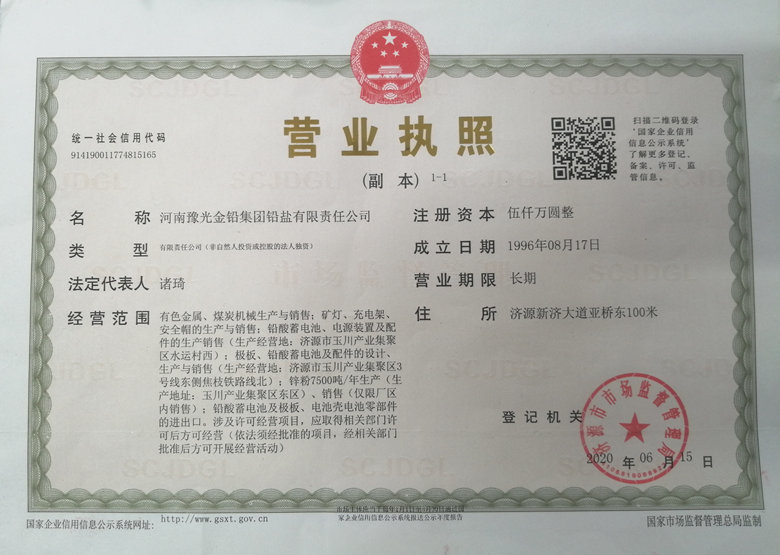
AboutHenan Yuguang Gold and Lead Group Lead Salt Co., Ltd. was established on August 17, 1996, headquartered in Jiyuan City, Henan Province, with more than 1,200 employees and more than 150 professional and technical

-
IndustryThe company has three production branches, five wholly-owned subsidiaries, and nine share holding companies. The main business scope includes lead-acid batteries, battery plates, chemical products and trade services.
-
ProductThe company pays attention to system construction, adheres to "integrity-based, quality first", achieves refined production, and continuously promotes environmental protection, production safety and quality improvement.
-
TechnicalThe company attaches great importance to scientific and technological innovation and quality improvement, continuously increases basic material science and applied scientific research, and actively builds a high-tech...
-
BlogThe company strives to build an inclusive, open and harmonious environment, and actively build a vibrant and positive corporate culture.

Blog
Build A Harmonious Environment And Actively Build A Vigorous And Positive Enterprise
Common faults and troubleshooting methods of lead-acid batteries
Time:
2021-06-07
The faults in the use of lead-acid batteries can be divided into external faults and internal faults according to the location.1) External failure: shell crack, pole pile corrosion, pole pile looseness and sealant dry crack.
The faults in the use of lead-acid batteries can be divided into external faults and internal faults according to the location.
1) External failure: shell crack, pole pile corrosion, pole pile looseness and sealant dry crack.
2) Internal failures: plate vulcanization, self-discharge, plate short circuit, active material shedding, plate grid frame corrosion and plate arching.
Common internal failures of lead-acid batteries:
1. Plate vulcanization
Failure phenomenon:
1) The battery capacity is reduced, and the single-cell voltage drops rapidly.
2) The density of the electrolyte drops below the specified normal value.
3) The voltage of the battery is too high at the beginning and the end of the charge, which can reach more than 2.7v.
4) The battery generates bubbles prematurely during charging, and even has bubbles at the beginning of charging.
5) The electrolyte temperature rises too fast when charging the battery, easily exceeding 45°C.
6) The voltage drops too fast when the battery is discharged (discharge with a low discharge rate), and it drops to the end voltage prematurely.
7) Generate hard, insoluble, large white particles on the plate.
cause of issue:
1) The battery is placed in the discharged and half-discharged state for a long time. Because the lead sulfate has a large temperature difference between day and night, the two opposite processes of dissolution and crystallization in the electrolyte continue to occur alternately, resulting in recrystallization. When crystallized, coarse and insoluble lead sulfate crystal grains are formed on the electrode plate.
2) The accumulator is often over-discharged or deeply discharged with a small current, so that lead sulfate is generated in the inner layer of the small pores of the electrode plate, and it is not easy to recover from charging.
3) The electrolyte level is too low, and the active material on the upper part of the electrode plate is exposed to the air to be oxidized. When the car is running, the fluctuation of the electrolyte makes it contact with the oxidized active material, producing coarse-grained lead sulfate.
4) The initial charging is not complete or regular supplementary charging is not performed. The initial charge of the battery is not complete or the regular supplementary charge is not performed during use, so that it can be used for a long time in a semi-charged state. The discharge product lead sulfate on the electrode plate will exist for a long time, and it will also form coarse particles through recrystallization.
5) The battery self-discharge due to impure electrolyte or other reasons will produce lead sulfate, thereby providing a material basis for the recrystallization of lead sulfate.
troubleshooting:
If the battery has a mild vulcanization failure, it can be charged with a low current of 2~3A for a long time, that is, overcharge; or use a full discharge and full charge cycle method to reduce the active material; it can also be eliminated by desulfurization charging. Severely vulcanized batteries should be scrapped.
Related Blog
"Energy density" refers to the amount of energy stored in a unit of a certain space or mass matter. The energy density of a battery is the electric energy released by the average unit volume or mass of the battery. The energy density of a battery is generally divided into two dimensions: weight energy density and volume energy density.
2021-06-07
Lithium battery step-up and step-down method, lithium battery step-up and step-down method
First, let the lithium battery drop to 3.3V through the step-down chip, and then supply power to the microcontroller and Bluetooth module, and plan to increase it to 7V to carry a load.
2021-06-07
Precautions for the installation of solar batteries
1) The installer (or engineering team) receives the installation task instruction, prepares relevant materials (such as battery installation of various manufacturers, record sheets, etc.) and a full set of installation tools (including multimeters, etc.), and confirms the start date of the project and the progress of the project, etc. .
2021-06-07
Telephone:+86 0391-6606986
Address:No. 680, East Section of Jishui Street, Jiyuan City, Henan Province
Copyright © 2023 Henan Yuguang Gold and Lead Group Lead Salt Co., Ltd.